Wednesday, March 29, 2006


Wednesday, March 15, 2006
Layman's guide to Kashmir crisis :-)
Last time I wrote about some probable solutions to the Kashmir problem. I think its time to roll the tape backwards by about 60 years. I call it the layman’s guide to Kashmir problem!
Circa 1947
India was given independence by Britain under an act called the INDIA INDEPENDENCE Act of 1947. Some of the salient elements of this act were that:
1) The subcontinent of India would be given independence on August 15th 1947.
Independence would mean that the British Raj will be terminated on the midnight of August 15th 1947.
2) The sub-continent would be divided primarily into two dominions INDIA and Pakistan
3) The princely states ( which were governed by the Maharajas viz Wodeyars) would have the option to either join India or Pakistan or remain free without joining any of the dominions.
After Independence the Dogra ruler of JnK, Maharaja Hari Singh exercising the third clause of the Independence Act decided to remain independent without joining either of the new dominions.
But Pak didn’t seem to agree to this decision of Hari singh. It claimed JnK to be an integral part of Pakistan based on the fact that majority of the Kashmiri population was Muslim and if given an option Kashmiris would any day vote to go with Pakistan. Pak implementing on this reckoning started infiltrating tribal irregulars also known as Razakkars into the valley. Its interesting to know that Pakistan till today maintains that it had no hand in this infiltration (much like its stand in the recent Kargil incident).
Hari Singh got to know the real threat when the Razakkars reached the outskirts of Srinagar. He swiftly ceded J and K to India to get military support to thwart the Paki irregulars. It is believed that Sheik Abdullah was by and large the biggest motivation behind this decision.
First Kashmir war: 1947-48.
Once the Document of accession was signed the first Indian troops started landing in Srinagar. The Indians reached Srinagar just at the exact time, one more day we would have lost Srinagar. Indian Army along a petite support from the Airforce successfully chased away the ‘so-called’ tribals from Srinagar. Valiant efforts from the likes of Major Somnath Sharma (1st PVC) recaptured Rajouri, Zoji-la, Uri and other parts Kashmir that were under Paki occupation. By December 1948 when India had just started gaining the upper hand, our ‘great’ pacifist PM who never trusted his army’s capability moved the case to UN. UN(pronounce ‘US’) arranged for a bilateral ceasefire that came into effect on Dec 31st 1948. The statement of ceasefire unanimously called for withdrawal of troops from either sides and also called for a plebiscite to decide the future of Kashmir. For obvious reasons India didn’t adhere to the plebiscite and Pak didn’t pull back its troops.
So from that day onwards the state of Kashmir was divided into PoK (Pak occupied Kashmir approx 1/3rd of the whole area; Pakis call it Azad Kashmir; capital: Muzzaffarabad ) and Jammu and Kashmir (pakis call it Indian occupied Kashmir; Capital: Srinagar) by the Ceasefire Line (called the LoC after the 1971 war).
So this is all about how the two Kashmirs were formed in 1948.

Click here for detailed political map of Jammu n Kashmir
Sept 1965: Operation Gibralter!
Operation Gibraltar (brain child of Ayub Khan) was the name given to the failed plan by Pakistan to infiltrate Jammu and Kashmir, India and start a rebellion. Launched in August 1965, Pakistan Army soldiers and guerrillas disguised as locals entered Indian held Kashmir from Pakistan with the intention of fomenting an insurgency among Kashmiri Muslims. However, the strategy went awry from the very outset, as the locals did not respond as expected and the infiltrators were soon found. The counter-offensive for this resulted in the 1965 war which ended in a stalemate. The result of this saw the 1966 Tashkent agreement between Lal Bahadur and Ayub Khan (brokered by Russian premier Kosygin) which was similar to the one that the UN talked about in.
65 war didn’t do any good to better the condition of crisis. By adhering to UN India again lost an opportunity to subjugate Pakistan militarily
Dec 1971: Bangladesh war.
Although the primary result of this war saw the formation of Bangladesh war, the Shimla agreement it also witnessed redrawing of the cease-fire line to form the LoC. The treaty is often viewed by many as having cemented the Line of Control as a permanent border between the two nations, although Pakistanis consider it temporary, pending a final solution.
71 war was some respite for the Indians and also for the Kashmir crisis as it saw the emergence of the LoC which more or less became a de-facto International border. The focus of the international community started to slowly sway away from the Kashmir crisis which according to them had reached a decisive stage after the war.
The 1984 Siachen crisis , terrorism in JnK and the most recent Kargil war of 1999 can all be viewed as futile efforts of a discontented Pakistan to regain international attention on this issue.

PS: This is an pic where I am trying to depict Paki terrorism in JnK during the 90s which US delibrately didnt notice. The reason was the re-found friendship with Pak during the Soviet occupation of Afganistan.
The crisis is still a national issue for both Pak and India. The ultimate is still not in sight. So till then, its all wait and watch for us. Hope it not all waitiiiiiiiiiiiing!
Circa 1947
India was given independence by Britain under an act called the INDIA INDEPENDENCE Act of 1947. Some of the salient elements of this act were that:
1) The subcontinent of India would be given independence on August 15th 1947.
Independence would mean that the British Raj will be terminated on the midnight of August 15th 1947.
2) The sub-continent would be divided primarily into two dominions INDIA and Pakistan
3) The princely states ( which were governed by the Maharajas viz Wodeyars) would have the option to either join India or Pakistan or remain free without joining any of the dominions.
After Independence the Dogra ruler of JnK, Maharaja Hari Singh exercising the third clause of the Independence Act decided to remain independent without joining either of the new dominions.
But Pak didn’t seem to agree to this decision of Hari singh. It claimed JnK to be an integral part of Pakistan based on the fact that majority of the Kashmiri population was Muslim and if given an option Kashmiris would any day vote to go with Pakistan. Pak implementing on this reckoning started infiltrating tribal irregulars also known as Razakkars into the valley. Its interesting to know that Pakistan till today maintains that it had no hand in this infiltration (much like its stand in the recent Kargil incident).
Hari Singh got to know the real threat when the Razakkars reached the outskirts of Srinagar. He swiftly ceded J and K to India to get military support to thwart the Paki irregulars. It is believed that Sheik Abdullah was by and large the biggest motivation behind this decision.
First Kashmir war: 1947-48.
Once the Document of accession was signed the first Indian troops started landing in Srinagar. The Indians reached Srinagar just at the exact time, one more day we would have lost Srinagar. Indian Army along a petite support from the Airforce successfully chased away the ‘so-called’ tribals from Srinagar. Valiant efforts from the likes of Major Somnath Sharma (1st PVC) recaptured Rajouri, Zoji-la, Uri and other parts Kashmir that were under Paki occupation. By December 1948 when India had just started gaining the upper hand, our ‘great’ pacifist PM who never trusted his army’s capability moved the case to UN. UN(pronounce ‘US’) arranged for a bilateral ceasefire that came into effect on Dec 31st 1948. The statement of ceasefire unanimously called for withdrawal of troops from either sides and also called for a plebiscite to decide the future of Kashmir. For obvious reasons India didn’t adhere to the plebiscite and Pak didn’t pull back its troops.
So from that day onwards the state of Kashmir was divided into PoK (Pak occupied Kashmir approx 1/3rd of the whole area; Pakis call it Azad Kashmir; capital: Muzzaffarabad ) and Jammu and Kashmir (pakis call it Indian occupied Kashmir; Capital: Srinagar) by the Ceasefire Line (called the LoC after the 1971 war).
So this is all about how the two Kashmirs were formed in 1948.
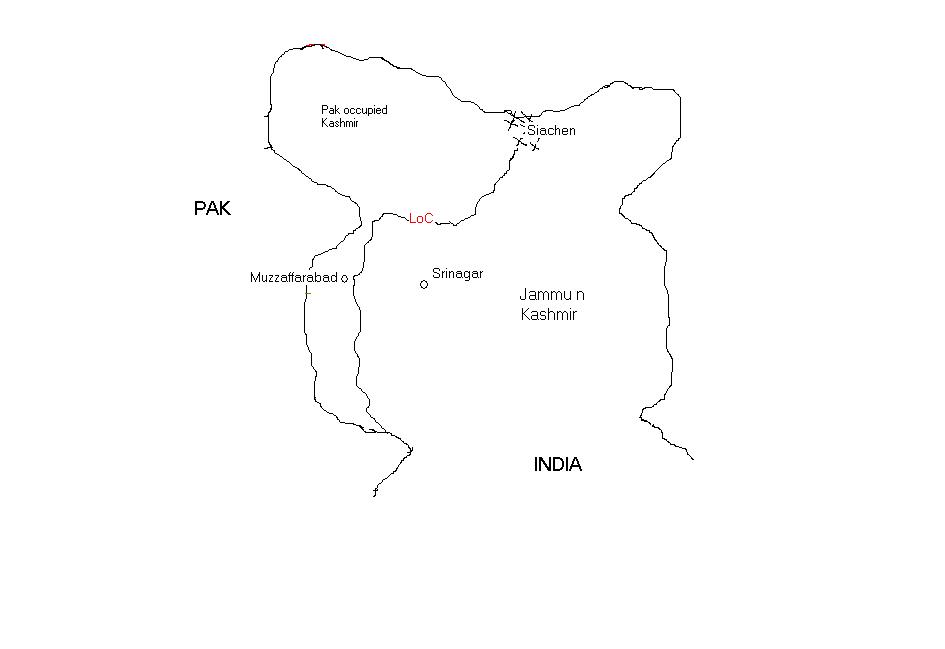
Click here for detailed political map of Jammu n Kashmir
Sept 1965: Operation Gibralter!
Operation Gibraltar (brain child of Ayub Khan) was the name given to the failed plan by Pakistan to infiltrate Jammu and Kashmir, India and start a rebellion. Launched in August 1965, Pakistan Army soldiers and guerrillas disguised as locals entered Indian held Kashmir from Pakistan with the intention of fomenting an insurgency among Kashmiri Muslims. However, the strategy went awry from the very outset, as the locals did not respond as expected and the infiltrators were soon found. The counter-offensive for this resulted in the 1965 war which ended in a stalemate. The result of this saw the 1966 Tashkent agreement between Lal Bahadur and Ayub Khan (brokered by Russian premier Kosygin) which was similar to the one that the UN talked about in.
65 war didn’t do any good to better the condition of crisis. By adhering to UN India again lost an opportunity to subjugate Pakistan militarily
Dec 1971: Bangladesh war.
Although the primary result of this war saw the formation of Bangladesh war, the Shimla agreement it also witnessed redrawing of the cease-fire line to form the LoC. The treaty is often viewed by many as having cemented the Line of Control as a permanent border between the two nations, although Pakistanis consider it temporary, pending a final solution.
71 war was some respite for the Indians and also for the Kashmir crisis as it saw the emergence of the LoC which more or less became a de-facto International border. The focus of the international community started to slowly sway away from the Kashmir crisis which according to them had reached a decisive stage after the war.
The 1984 Siachen crisis , terrorism in JnK and the most recent Kargil war of 1999 can all be viewed as futile efforts of a discontented Pakistan to regain international attention on this issue.
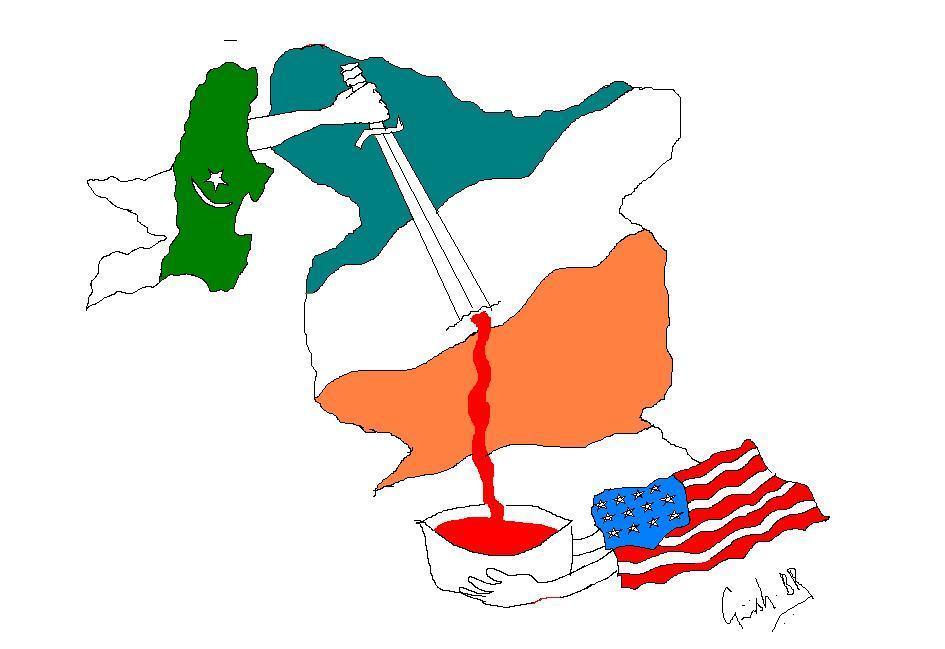
PS: This is an pic where I am trying to depict Paki terrorism in JnK during the 90s which US delibrately didnt notice. The reason was the re-found friendship with Pak during the Soviet occupation of Afganistan.
The crisis is still a national issue for both Pak and India. The ultimate is still not in sight. So till then, its all wait and watch for us. Hope it not all waitiiiiiiiiiiiing!
Saturday, January 28, 2006
Secularism and Kashmir
Secularism and Kashmir
26th Jan 2006: Republic Day in India.
11 AM in the morning. The meaty part of the parade was over. I guess this is the 8th consecutive year I have been watching the republic day parade with such fervor. Unlike last time the parade was headed by the home made Arjun tanks, last time it was T-90 Bhishma. Bhisma or Arjun, the sight of those massive 60 odd tonne tanks marching across the Rajpath was an absolute visual delicacy. Security forces in New Delhi must have sighed a relief after the entire proceedings got over. But the real respite was for the security forces of a city that lies about 850 km north of Delhi. Bakshi stadium, the main venue for Republic Day celebrations in Srinagar , well can almost be called Bakshi Fort. Republic day is an occasion when an ordinary Indian takes the pride of being an Indian. The situation in Kashmir is totally different. I would say that hardly any Kashmiri feels this pride. I am not blaming the people of Kashmir for this. Of course no one would like to be a part of a setup wherein you are suspiciously looked all the time and your actions are restricted by a strong iron hand. Neither am I blaming the Indian army for doing what they are doing in J and K. They have handled the proxy war situation in JnK in the best possible manner. Infact they are one among the most trigger-unfriendly security forces in the world, yet are very potent. These qualities make our Army one of the most desired peace keeping forces in the world, even US wanted us to be in IRAQ. Now let’s focus back on Kashmir. Off late there has been a drastic decrease in the amount of foreign terrorism that has been flowing into the valley, but this hasn’t changed the common Kasmiri’s attitude towards India. With all due respect, I would say that successive Indian govts have alienated the people of Kashmir, in a way they have started feeling that they being ruled by a colonialist power. This according to me is the main problem of Kashmir.
I agree that the fire was lit by Pakistan but we never wanted to look through the fire and see what is that which is actually blazing underneath. Looking closely at the Kashmir problem, Jammu and Kashmir has three diverse components - Hindu majority Jammu, Buddhist dominated Ladakh in the North and predominantly Muslim populated Valley, besides what is under Pakistan occupation. Pakistan's eyes are set on Kashmir on the pernicious two-nation theory. Never mind the fact that despite partition of the sub-continent into India and Pakistan in 1947 by the British, India still has the world's second largest Muslim population, around 120 million, next only to that of Indonesia.
After the 1st Kashmir War of 1948, the ceasefire line (which later became the Line of control) was drawn to divide Kashmir into Pakistan Occupied Kashmir (PoK) and Jammu-Kashmir. But Pak was never satisfied with what it got. Playing the two nation theory card, it wanted the complete of JnK. To make its claim stronger Pak sponsored terrorism gave in to ethnic cleansing of Kasmiri Pundits from the valley. And yes Pak was successful in doing this. The Pundits for whom Kashmir was their home abode were made refugees in their own homes. Pundits leaving Kashmir has bolstered pak’s claim based on the two-nation theory. Now Kashmir problem is headed for a stalemate for India.
For how long will you continue like this?
How many more lives will be sacrificed?
For how many more years will you waste taxpayer’s money like this?
How many more lives will be sacrificed?
For how many more years will you waste taxpayer’s money like this?
There has to be an end, a solution which will put an end to all this.
A final Decisive war ?
A final Decisive war ?
But I don’t think that would be easy. Seeing the current political scenario, I would say that the probability of another full scale Indo-Pak war is very bleak mainly because of the nuclear status both nations have achieved. This was very much proven during the Kargil war when Atalji didn’t do a ‘la Lal Bahadur Shastri by not crossing the LoC. The situation during Kargil war was very similar to the situation during 1965 when Lal Bahadur decided to cross IB and teach Pak a lesson. But Atalji never did that because the initial odds against India were two heavy. The 99 kargil war never became a full scale war ,it remained a small conflict restricted to a particular region. India might have won the last big war the 1971 war against Pak. But the scenario now is totally different. Although Pak govt is totally anarchic the army still remains well disciplined. What I would like to implicate from this is a decisive war may be an ultimate victory for us, but the initial losses that we have to take is too much.
Plebiscite ?
Coming to the prob of JnK; I don wanna say this, but If a Plebiscite is held in JnK do u think the people of JnK will vote to stay with us? No…No chance That’s why India repeatedly has denied Pak's suggestion of a UN plebiscite. Showing love n affection to the people of Pak won’t help, but showing love and affection to the people of JnK will definitely help. Holy Jesus always told "Love your neighbor" But how will you do it if you are not allowed to stay in front of that Kashmiri whom you want to be friendly with. I am saying this coz no Non-JnK resident is allowed to buy land or any kind of property in JnK. There r many other special provisions other than this which come very much under our constitution. So the problem is in Delhi not in Srinagar. The main prob of JnK is its demography n geography. JnK as I have quoted earlier is a state where people of a particular community have accrued. I don’t say this is off beam. But this has become a problem coz of Jnk's geographical closeness to Pakistan. People on both sides of the border or Loc look alike, speak the same language and largely are from the same religion. So I don’t blame the ordinary Kashmiri's proclivity towards Pakistan. The solution for this is within us. We must follow the Chinese model to make JnK more Indian...
Plebiscite ?
Coming to the prob of JnK; I don wanna say this, but If a Plebiscite is held in JnK do u think the people of JnK will vote to stay with us? No…No chance That’s why India repeatedly has denied Pak's suggestion of a UN plebiscite. Showing love n affection to the people of Pak won’t help, but showing love and affection to the people of JnK will definitely help. Holy Jesus always told "Love your neighbor" But how will you do it if you are not allowed to stay in front of that Kashmiri whom you want to be friendly with. I am saying this coz no Non-JnK resident is allowed to buy land or any kind of property in JnK. There r many other special provisions other than this which come very much under our constitution. So the problem is in Delhi not in Srinagar. The main prob of JnK is its demography n geography. JnK as I have quoted earlier is a state where people of a particular community have accrued. I don’t say this is off beam. But this has become a problem coz of Jnk's geographical closeness to Pakistan. People on both sides of the border or Loc look alike, speak the same language and largely are from the same religion. So I don’t blame the ordinary Kashmiri's proclivity towards Pakistan. The solution for this is within us. We must follow the Chinese model to make JnK more Indian...
- The Chinese after occupying Tibet in 1959 did a wily job of getting native Chinese to Tibet. In the due course of time this action bore the fruits. With time the mainland Chinese mingled very well with the local Tibetans…and now people in Tibet no longer feel that they are different. This is coz they r demographically n politically closer to mainland China when compared to the situation of an common Kashmiri’s relation with India.
- Although India never forcibly occupied JnK, the way we are governing it very much demonstrates that the situation here is very similar to the situation of Tibet n China in the 60s...
- We have to rewrite our laws to do what Chinese did to get Tibet into their folds. One way is to throw open the real estate market of JnK to all Indians. Non Kasmiris must be allowed to do biz in JnK. This will help the people of JnK too. These tricks worked for us in the case of Northeast…The NE people are demographically not similar to the majority of India. Even then NE hasn’t been such a big issue to us coz u can see many Bengalis, Biharis, Punjabis n off late some Tamilans in Kohima ,Imphal or Shillong…or any other city of NE for that matter.. The same thing has to be enacted in JnK too...India is secular. So Secularism must flow to JnK too..This is the only Solution for this problem...
- The problem of JnK didn’t take one day to achieve this monestrous proportion. So the solution too won’t be an instant one. We don’t have an immediate solution for this .Till now Pakistan has played with us, its now our turn to rule the roost. There is common saying that “When you have a fire in your own backyard, you won’t go out to see what’s happening in your neighbor’s backyard”. So keep if Pakistan wags its ugly tail too much put its backyard on fire. Candidly speaking there is already a veiled fire that Pak is desperately trying to douse. We just have to rekindle this fire which is geographically called Baluchistan”.
Pakistan as such is dominated by the Punjabis in all respects. In the last 57 yrs Pakistan has literally done nothing to improve the life of the Baluchis .The Baluchis who are very much a part of Pakistan (the stan in Pakistan’s name is derived from Baluchistan) don’t enjoy the same life as that of the Punjabi. The Punjabis (Paki pres Musharraf is a Punjabi) been successfull in recreating the civil war situtation of 1971(involving East Pakistan) in Baluchistan today. Baluchistan infact the largest province of Pakistan is worst than Somalia. Even though Baluchistan is used for all nuclear aspirations of Pakistan (Chagai hills is a part of Baluchistan), Ordinary Baluchi leads a atrocious impoverished life with literally no basic amenities and infrastructure. Any Baluchi voice against this Punjabi oppression is dealt with a heavy hand. Off late there have been incidents of Pakistan trying to use Helicopter-Gunships and Tanks to suppress Baluchi separatists. Pak has resorted to genocide of Baluchis to solve the Baluchi deadlock. More info on <http://www.balochvoice.com/> .Baluchistan is all sent to become the next Bangladesh...So Follow Indira Gandhi’s footsteps.
I think I have made myself clear in what I wanted to say. If we go out on a full scale war, I agree eventually v will win. But Pakistan doesn’t have the "No first Use" policy regarding its nukes. If we go out on a full scale war Pakistan without any doubt will be the first to use nukes in order to make up for the heavily imbalanced conventional might of India against it. So there will be heavy losses on both sides...N finally what will happen?? Everything will normalize when a pacifist PM (like Nehru) will come to power n back to square one...So war wont help...
Kindly air your views on the same
Subscribe to:
Posts (Atom)